
To keep this guidance fresh, we validated platform features and industry sources within the last two weeks. You'll find links to official announcements and authoritative reports throughout so you can brief your team with confidence.
TL;DR - Key Takeaways
- •Social commerce is now the operating system of creator marketing—conversion happens inside the entertainment stream
- •Long-term creator partnerships (3–6 months) outperform one-off posts with compounding returns
- •Shoppable CTV via YouTube Demand Gen extends creator content to living-room screens
- •Measurement maturity requires blended models: UTMs, experiments for lift, and MMM for marginal ROI
- •Compliance is table stakes—use platform-native disclosure tools and align to FTC/EU regulations
Why 2026 is different for social commerce
Platforms have spent the last 18 months stitching shopping into the content experience. YouTube's leadership laid out a 2026 roadmap that emphasizes more seamless shopping and a stronger creator–brand collaboration stack in its CEO outlook (Jan 21, 2026). See the details in the company's post, From the CEO: What's coming to YouTube in 2026, published on the official blog: YouTube's 2026 outlook highlights deeper brand–creator tooling and shoppable experiences.
Google also expanded shoppable surfaces across screens. Demand Gen now powers Shoppable CTV so viewers can browse and purchase while watching YouTube ads on TV screens; Google noted early tests saw incremental conversions at similar ROI in its January 22, 2026 update: Google's Demand Gen adds Shoppable CTV with early incremental conversion gains.
TikTok, meanwhile, continues to scale commerce natively. The platform reported more than 8 million hours of LIVE shopping hosted in 2024 and ongoing momentum into 2025, per its newsroom post last updated November 19, 2025: TikTok says shoppers "come to discover" on TikTok Shop and cites LIVE shopping scale. In category terms, TikTok also pointed to double-digit growth in UK beauty via TikTok Shop in 2025, reported January 25, 2026: TikTok Shop highlights 60% YoY beauty growth in the UK in 2025.
Two takeaways for operators:
- Social video is no longer just upper-funnel. With shoppable video and native live commerce, conversion can happen inside the entertainment stream.
- The bar has moved from "sponsored content" to "shoppable programming" that's sustained by durable creator relationships and repeatable formats.
The full-funnel playbook for social commerce
Here's the deal: 2026 rewards teams that design creator programs as always-on, measurable commerce engines. Use this five-step framework to align strategy, creative, and measurement.
1. Plan: audience, product, offer
- Clarify the shopping job to be done (discovery, trial, repeat purchase). Map your hero SKUs to short-form hooks and live demo potential.
- Define the funnel you can realistically power: in-app checkout vs near-funnel (landing page + one-click payment).
- Set success thresholds by stage (e.g., engaged view rate, session starts, add-to-cart rate, incremental lift).
2. Creators: selection and long-term terms
- Choose creators for fit and format stamina. Prioritize those who can carry a live series or episodic Shorts/Reels, not just one viral post.
- Structure 3–6 month partnerships with performance clauses and content cadences (e.g., 2 Shorts + 1 Live per month, rotating SKUs).
- For discovery, combine platform-native marketplaces with AI-powered matching. If you're building a TikTok-heavy motion, see this tactical guide to find TikTok influencers. For YouTube-centric programs, this overview on YouTube creator discovery outlines selection criteria.
3. Creative: shoppable assets that sell
- Short-form: lead with a strong hook in the first 2 seconds, then demo, social proof, and a single clear action ("tap to shop").
- Live: design segments (demo, Q&A, limited-time bundles) and pin products strategically; rehearse handoffs to maintain session energy.
- Standardize creative briefs and SKU callouts so links, codes, and disclosures are correct every time.
4. Commerce: connect content to checkout
- Use platform-native product tagging and shopping features when available; where not, route to fast-loading PDPs with social-proof blocks.
- For TV/CTV placements, test shoppable flows as part of your YouTube media mix using Demand Gen's new capabilities.
- Establish an affiliate structure that rewards creators for both immediate sales and assisted conversions over a defined window.
5. Measurement: prove incremental value
- Track micro-KPIs by funnel stage: engaged views, session starts, PDP views, add-to-cart, checkout starts, purchases, and 30/60/90-day LTV.
- Run incrementality tests (geo holdouts or audience splits) and feed results back into MMM for budget allocation.
- Standardize weekly pulse reports and monthly experiment readouts so QBRs roll up cleanly.
Influencer marketing trends 2026 you can act on now
Trend 1 — Social video to storefront, without the detour
Shoppable Reels/Shorts and live shopping sessions are converging with native checkout and affiliate rails. On YouTube, the company's BrandConnect and creator partnerships hub, detailed across 2025 posts, make it easier for brands to brief creators and link content into ads with proper measurement: Google outlined creator–brand collaboration tooling in 2025. The upshot: your creative plan and your commerce plan should be one plan.
Trend 2 — Long-term creator partnerships over one-offs
Performance compounds when creators learn your product, your audience, and your seasonal triggers. Shift budgets from bursts to programs—recurring live sessions, serialized Shorts/Reels, and co-created bundles that roll from new-customer offers to retention.
Trend 3 — Shoppable CTV joins the mix
As Google rolls out Shoppable CTV via Demand Gen, brands can extend creator content and product showcases to living-room screens with commerce actions. Expect CTV to become a complementary mid-funnel driver alongside short-form and live.
Trend 4 — Measurement maturity, not just more dashboards
Teams are moving from single-touch attribution to blended models that combine UTMs/codes, experiments for lift, and MMM to set marginal ROI curves. For a clear overview, see LifeSight's 2025–2026 guidance on experiment design and incrementality: LifeSight explains how to measure influencer programs and design geo experiments. CreatorIQ's early-2026 planning notes also stress measurement planning as a first-class workstream: CreatorIQ outlines how to build a measurement plan in 2026.
Trend 5 — Compliance and transparency become program design inputs
Disclosure-by-design is table stakes. In the US, align to the FTC's Endorsements, Influencers, and Reviews guidance and the 2024 Consumer Reviews and Testimonials Rule; use platform-native disclosure tools and keep copies of briefs and scripts. Start with the FTC resource hub for primary references: FTC's official endorsements, influencers, and reviews guidance.
Measurement and attribution that stand up in QBRs
Think of your measurement plan like the tracks your commerce train runs on: if they're crooked, everything wobbles. Standardize the KPI taxonomy and build experiments into your operating rhythm.
Micro‑KPI taxonomy by funnel stage
| Funnel Stage | Primary Metrics | Secondary Metrics |
|---|---|---|
| Attention (Short-form) | Engaged view rate; 3-sec/6-sec views | Saves; shares |
| Consideration (Live) | Session starts; average watch time | Click-through to product; chat engagement |
| Conversion (Checkout) | PDP views; add-to-cart; checkout starts | Promo-code usage; assisted conversions |
| Revenue & LTV | Purchases; repeat rate | 30/60/90‑day LTV; CAC payback |
First 90 days: your measurement checklist
- Implement clean tracking: UTMs on all links, unique creator codes, and server-side events if available.
- Design one lift test per major channel: geo holdout for multi-market or audience split where geo isn't possible.
- Pre‑register success thresholds (e.g., +8–12% incremental sales lift or iROAS target) and lock the readout window and sample sizes.
- Calibrate MMM quarterly using experimental priors; use MTA for touchpoint granularity, not causality.
- Report weekly pulse (creative/micro-KPIs) and monthly experiment readouts (lift, confidence, action).
For added context on MMM, Nielsen's overview is a useful grounding point: Nielsen describes how MMM estimates incremental ROI and optimizes mix.
Risks, compliance, and brand safety
Live commerce and short-form ads compress discovery and conversion, which makes transparency even more important. In the US, align to the FTC's Endorsements guidance and keep current with the Consumer Reviews and Testimonials Rule (finalized in 2024) and subsequent enforcement updates. You can find the foundation materials here: FTC resource hub on endorsements, influencers, and reviews.
For the EU, ensure ads are clearly identifiable and minors are protected under the DSA and AVMSD; reference the primary legal texts on EUR-Lex for policy and compliance teams: Digital Services Act primary text on EUR‑Lex and AVMSD primary text on EUR‑Lex. The European Commission has also highlighted creator disclosure expectations in press materials in 2025.
A simple funnel to guide creative, commerce, and reporting
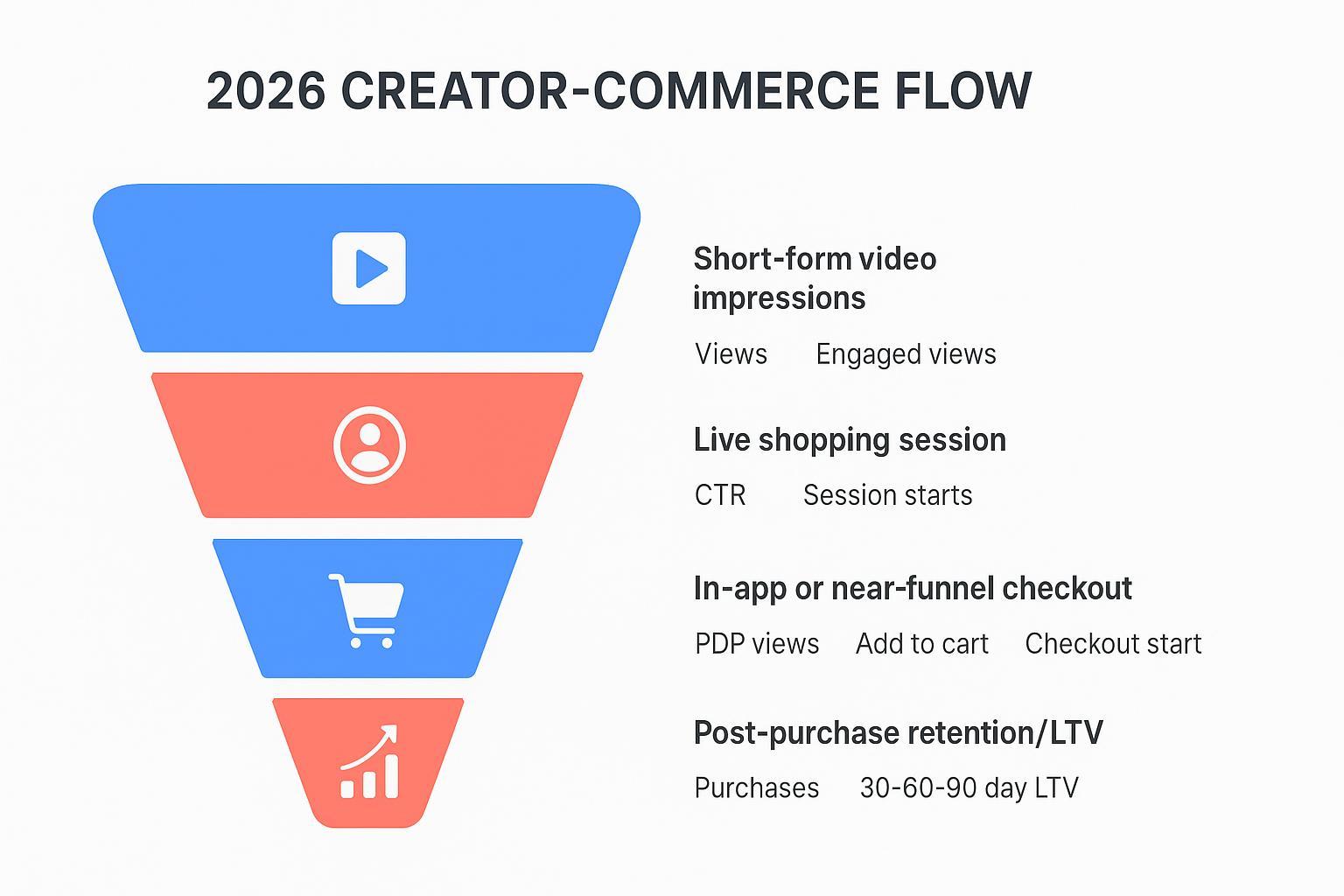
Short-form primes attention and click intent, live sessions convert interest into cart action, and in-app or near-funnel checkout removes friction. Post-purchase, shift creators to loyalty hooks: usage tips, new-sku reveals, and seasonal packs.
A practical AI workflow for creator commerce
Disclosure: Janney AI is our product. This neutral example shows how an autonomous agent can support your team's workflow.
Example — running a TikTok Shop LIVE series with an AI assist
Discovery and shortlisting: Pull a list of creators who match your audience and performance goals; filter by past live performance and brand safety signals.
Creative brief and outreach: Auto‑draft briefs with SKU callouts, disclosure language, and link/codes pre‑inserted; send outreach for approvals in one batch.
Tracking and reconciliation: Assign unique links/codes per creator and LIVE; aggregate add‑to‑cart and purchase data for weekly pulse and monthly lift readouts.
If you want to try an agent workflow, see this tutorial on getting started with an AI agent. For broader context on the tooling landscape, you can also review a neutral roundup of influencer search platforms.
What to do next
- Pick one primary format to scale this quarter (e.g., weekly live shopping or serialized Shorts) and tie it to a single conversion flow (in‑app checkout or a near‑funnel landing page).
- Lock a 3–6 month creator partnership structure with cadence, creative pillars, and clear performance thresholds.
- Instrument measurement properly: define micro‑KPIs, run one incrementality test per major channel, and synthesize into a quarterly MMM update.
- Pilot Shoppable CTV extensions as you build creative depth in short-form and live.
Interested in an AI agent to compress discovery, outreach, and reporting? Explore the tutorial above, or if you're ready to price a pilot, you can review pricing options.